
Everything I know about computers comes from YouTube tutorials, forums, and whatever LLMs tell me. What I lack in formal training, though, I make up for in curiosity. I’m intrigued by how technology works and how it shapes our society.
I’ve written about our digital footprint, and the more I think about it, the more convinced I am that we need to reclaim some autonomy over it. Technology has become so integral to our lives that it’s too important to simply hand over to a handful of companies.
That’s why I’m building a home server.
What Is a Home Server?
Ask 10 different IT guys, and you will get 10 different answers, but in its simplest form, it’s just a computer that runs 24/7 in your home. It’s a dedicated machine that provides services to other devices on your network or even across the internet if you set it up that way.
You’ll see different terms thrown around: home server, home lab, NAS (Network Attached Storage). They’re all variations on the same basic concept. A NAS is typically focused on file storage. A home lab might include multiple machines for experimenting with different configurations. But fundamentally, they’re all just computers running to provide services you’d otherwise pay cloud companies to handle.
Most people running home servers use Linux-based operating systems, which let you run multiple virtual machines on a single piece of hardware. That’s absolutely the “right” way to do it if you want maximum flexibility and efficiency.
Yet I will be running Windows for now. It’s what I know, and I want to get started right away. I’ll always have the option to switch to a Linux setup with multiple virtual machines later on, once I learn the ropes.
Why Build a Home Server?
Right, so it’s a computer that’s always on. Why would you want that?
Privacy and Ownership
Every photo on iCloud, every document in Google Drive, every file in Dropbox, you’re renting space on someone else’s computer. They can change the terms, raise the prices, shut down the service, or use your data to train AI models.
A home server means your data lives on hardware you control, in your home, under your rules. You become your own cloud provider.
Run Your Own Services
Want to host your own website? Set up a media server? Set up a smart home? With a home server, you can. You’re no longer dependent on whether a service exists or whether you can afford the subscription. If you can install it, you can run it.
Save Money (And Maybe Earn Some)
Here’s what you could potentially replace:
- Google Drive/iCloud subscriptions: $10-15/month, depending on your plan.
- Streaming service costs: If you run Plex or Jellyfin, you can stream your own media library. $10-15/month depending on your plan.
But here’s where it gets really fun: you might actually earn money from your home server.
GPU and CPU sharing: Platforms let you rent out your processing power when you’re not using it. With a good GPU, you could earn $50-100/month, depending on demand. CPU sharing offers smaller returns (maybe $10-30/month), but it’s passive income from hardware that would be idle anyway.
Running storage nodes: For instance, on services like Storj. You rent out unused hard drive space and bandwidth to earn (digital) currency. When someone uploads a file to Storj, it gets encrypted, split into pieces, and distributed across thousands of nodes worldwide. Your server stores fragments; you never have the complete file, and everything is encrypted.
Some estimates say roughly $1.50 per TB stored per month. But this is only after a lengthy vetting process that can take months. Other reports lower numbers.
In reality, the financial case is weak unless you already have hardware sitting idle. And I haven’t even accounted for electricity costs yet. You’d earn more working minimum wage for the hours spent on setup and maintenance. But if you’re curious about decentralised technology and want hands-on learning, it’s an interesting experiment that might cover a Netflix subscription.
Media Server Freedom
For many people, this alone justifies the entire project. Set up Plex or Jellyfin, point it at your media library, and suddenly you have your own Netflix. No licensing restrictions, no content disappearing because rights expired, no paying for multiple streaming services. Everything in one place, accessible from any device.
Running Your Smart Home
Smart home technology is genuinely useful, but I have no (and I strongly believe no one should) interest in letting big tech companies control it. That’s far too privacy-invasive. Every device phoning home to Amazon, Google, or others is tracking what time you wake up, when you’re home, and which rooms you use.
A home server changes that equation. With Home Assistant or similar open-source platforms, you can run your entire smart home locally. Your data stays in your home. You control what communicates with the outside world and what doesn’t. The automation still works, but without corporate surveillance as the price of admission.
Learning
Building a home server forces you to learn how the internet actually functions, not just how to use it. You’ll understand networking concepts that previously seemed abstract, including IP addresses, DNS, routers, subnets, and how data moves from point A to point B. All great skills to have as everything becomes increasingly digital.
For me specifically, working in risk management, this is valuable professional development.
Cybersecurity risk is one of the fastest-growing concerns in every organisation. This project provides practical knowledge of how systems are secured, where vulnerabilities typically arise, and which controls are effective versus those that are just security theatre. That makes me better at my job.
Yes, there’s genuine risk involved in opening your home network to the internet. But learning how to manage that risk properly, making informed decisions about what to expose, how to secure it, and how to monitor for problems, is precisely the kind of practical experience that translates directly into professional competence.
The Project Begins
What I’m Working With
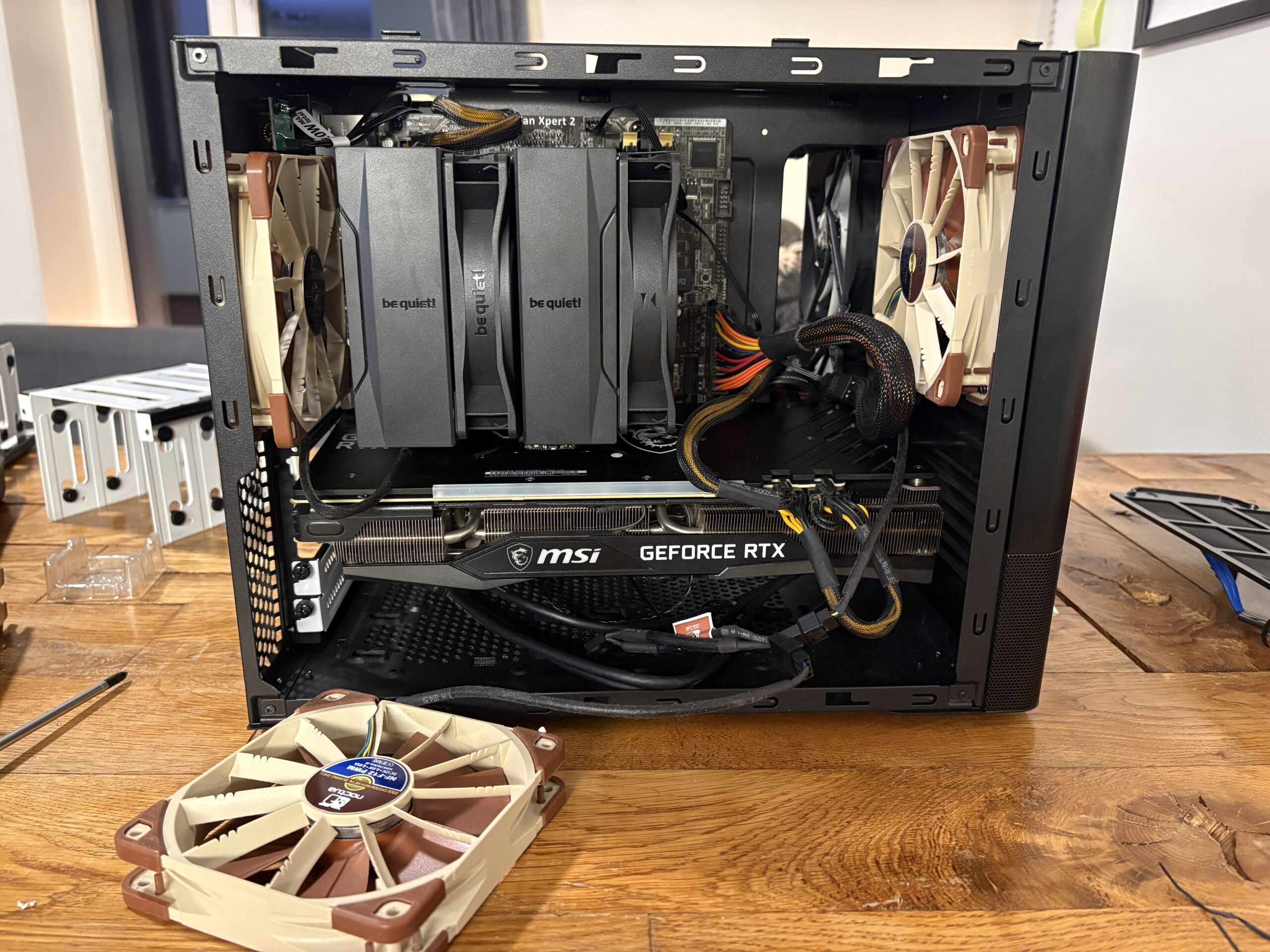
I’m combining hardware I already own with some new purchases. Here’s the full build:

The Foundation
- Case: Fractal Design Node 804
- CPU Cooling: be quiet! Pure Rock Pro 3 LX
- Case Fans: Six total—three Noctua 120mm and three Fractal 120mm
- Power: Corsair VS550 (first thing to upgrade for better efficiency and reliability)
The Computing Power
- CPU: Intel Core i7-4770K (4 cores, 8 threads) from 2013—old but capable
- Motherboard: ASUS H87M-PLUS with six SATA ports for future storage expansion
- RAM: 28GB DDR3 total (combining my existing 12GB with 16GB from the purchase of my Node Case)
- GPU: NVIDIA GeForce RTX 3060 for Plex transcoding and potential compute tasks
Storage
- 1TB SSD (C drive, OS and applications)
- 120GB SSD (old boot drive from previous build, repurposed for cache or temp storage)
- 1.7TB SSD planned for personal cloud storage
- Room for expansion: the motherboard’s six SATA ports and the Node 804’s drive bays leave plenty of options for adding more storage as needed
The pipeline
I’ll be looking for 3 additional hard drives and a quieter, more reliable power supply.
Are Home Servers a “Public Good” or a “Public Bad”?
In sociology and economics, a public good is a resource that benefits society at large, such as fire departments or street lighting. Everyone benefits from it, and one person’s use doesn’t prevent others from benefiting. A public bad is the opposite: something that imposes costs or harms on society, like pollution or traffic congestion.
So, where do home servers fit?
The Sustainability Question
One question I keep coming back to: is running a home server a public good from a sustainability perspective?
At first glance, home servers are less sustainable. Big data centres are optimised for efficiency in ways a home server never will be. But efficiency isn’t the whole story. Massive data centres concentrate environmental impact in ways that create serious local problems. They’re known for depleting fresh water reserves in their regions. The efficiency gains are genuine, but the concentrated impact on small geographic areas is also very real.
Home servers are less efficient per computation. That’s just physics. But there are some interesting counterarguments:
First, the hardware often already exists. I’m not buying new components manufactured specifically for this project. I’m repurposing a PC that would otherwise sit unused. Second, and this is where it gets interesting for those of us in cold climates: waste heat isn’t always waste.
I live in Stavanger. It’s February. My apartment has electric heating. When my GPU runs, it produces heat at roughly the same efficiency as when I turn on my electric heater. Both simply convert electricity into heat. The difference is that the GPU is also doing useful computation whilst producing that heat.
If I’m running server processes during winter and consequently running my electric heater less, I’m potentially getting dual-purpose use from the same energy. One kilowatt-hour produces both heat and compute instead of just heat. In that scenario, I might end up at net zero in electricity consumption.
Of course, this calculation completely flips in summer. Extra heat in summer isn’t welcome. And if you live somewhere warm year-round, this argument doesn’t hold at all. Geography and seasonality matter here.
The Jevons Paradox
Then there’s the uncomfortable question: what if distributed home servers just mean we use more AI?
Jevons paradox tells us that when something becomes more efficient or cheaper, we don’t use less of it, we use more. If home servers make AI processing cheaper and more accessible, we’ll simply run more AI tasks. The question isn’t whether my home server is more efficient than a data centre. It’s whether home servers replace data centre capacity or just add to total consumption.
That’s the counterfactual we can never quite know.
AI is going to progress regardless. There are billions being invested in data centre infrastructure. The technology will advance whether or not I build this server. So perhaps the better question is: given that AI development is happening anyway, is it better to use existing hardware that would otherwise go unused, or to demand new data centre capacity?
The Autonomy Argument
We have no control over how big data centres use their processing power. None whatsoever. When you rely entirely on centralised cloud services, you’re dependent on what a handful of companies decide to prioritise. If they decide to pivot their compute resources elsewhere, you’re along for the ride.
A more distributed model means more resilience. Individual control. The ability to switch providers or self-host entirely if needed. That has value beyond the efficiency calculation.
No Clear Answer
I don’t have a neat conclusion here. The sustainability question is genuinely complex, and the same goes for autonomy and privacy, which can be used for both good and bad causes.
What I am certain of is that his discussion is increasingly important, and I hope this blog post will contribute to it.
Next Steps
The hardware is assembled. Now comes the interesting part: actually making it do things.
I’ll be documenting the journey as I work through:
- Learning practical cybersecurity and securing access to the outside world
- Setting up my own cloud storage to replace my paid subscription.
- Adding more hard drives and experimenting with Storj.
- GPU/CPU sharing
- Running virtual machines (once I migrate from Windows to a proper virtualisation setup)
- Maybe even hosting this blog from my own server, though I’ll probably start with a test website first.
The Bottom Line
Having a home server creates lots of opportunities. From improving your digital autonomy to saving costs, and potentially even earning some money from your unused equipment. All whilst learning practical IT skills along the way.
I hope this blog post will spark interest among those who are not yet familiar with home servers and contribute to a productive discussion on decentralisation. I will certainly be posting more about this as my prject evolve.
Have you built a home server? Thinking about it? What’s your take on whether home servers are a ‘ public good’? I’d be interested in hearing your experience.