
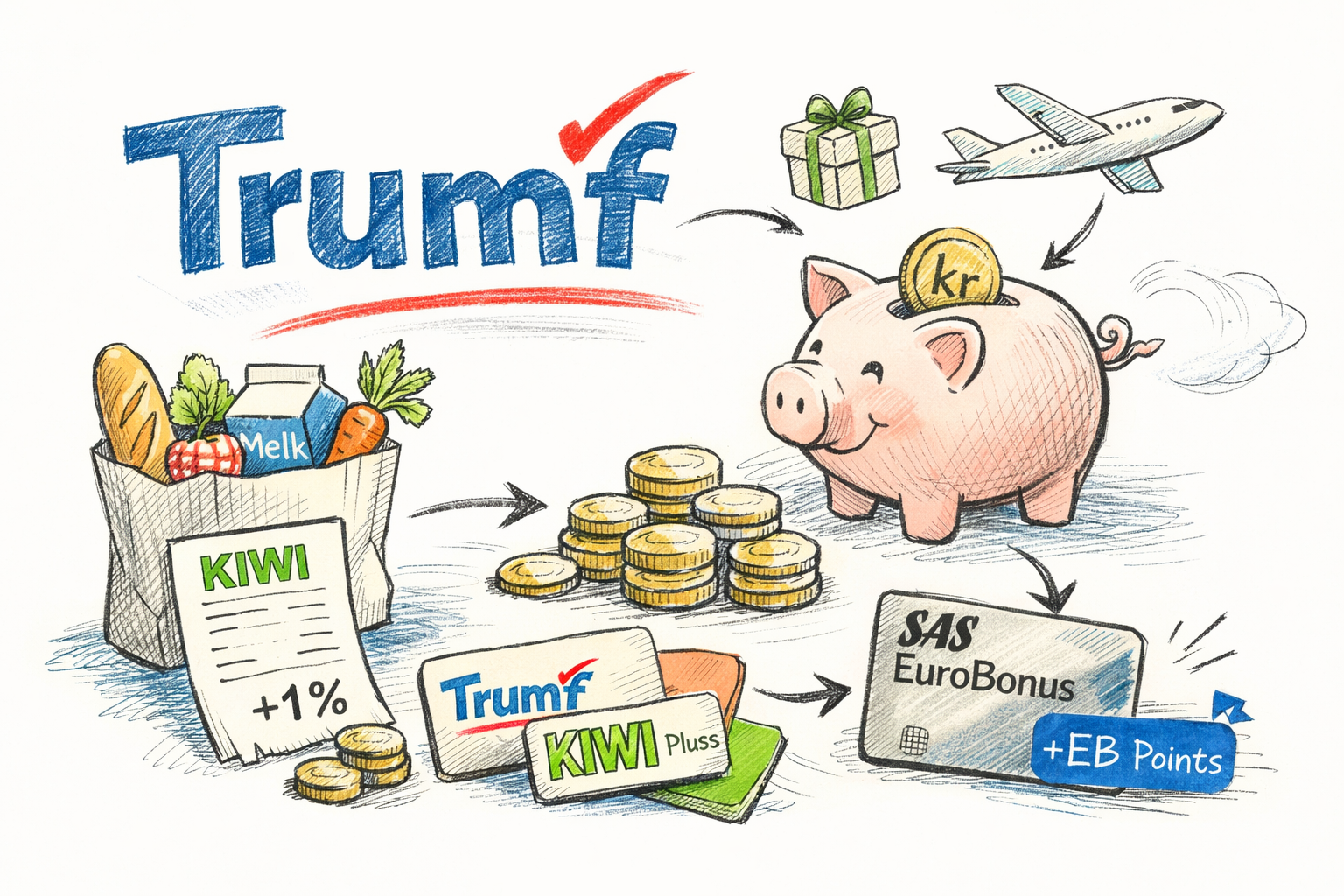
Groceries in Norway are expensive. So it is worthwhile to take a moment and look into the loyalty programs of different supermarkets. With Trumpf, you can save 1% on all you buy at the supermarkets owned by NorgesGruppen.
What Is Trumf?
Trumf is Norway’s largest loyalty programme, owned by NorgesGruppen, the company behind grocery chains like KIWI, MENY, SPAR, Joker, and Jacobs. With over 3 million members (in a country of about 5.5 million), it’s safe to say most Norwegians are on board.
The concept is simple: you earn 1% bonus on everything you buy at NorgesGruppen stores. That’s 1 krone back for every 100 kroner spent. It doesn’t sound like much, but it adds up. And unlike some loyalty programmes that make you jump through hoops, Trumf is passive. You register once, link your bank card, and forget about it.
How to Get Started
Getting started with Trumf is free and takes about five minutes.
- Register on trumf.no or download the Trumf app.
- Link your bank card (it needs to be a BankAxept card). This way, your bonus is registered automatically every time you pay, no scanning required.
- Optionally, order a physical Trumf card or use the digital one in the app for situations where you pay with cash, a credit card, or a smartwatch.
Once set up, every time you tap your bank card at KIWI, MENY, SPAR, Joker, or Jacobs, your 1% bonus is saved silently in the background. You don’t need to think about it. That’s the beauty of it.
Stacking Your Bonuses
The base rate of 1% is just the starting point. NorgesGruppen has built in several ways to earn more, and this is where it gets interesting.
KIWI PLUSS gives you 15% Trumf bonus on all fruit and vegetables. Signing up is free through KIWI.
Trippel-Trumf Thursdays happen a few times a year. On these days, your bonus triples from 1% to 3% at all NorgesGruppen stores.
Trumf Pay is NorgesGruppen’s own mobile payment solution within the Trumf app. If you pay with Trumf Pay instead of your regular bank card, you get an extra 1% bonus on top of whatever you’re already earning. So that’s 2% on a normal day and 4% on a Trippel-Trumf Thursday.
Trumf Kredittkort (Trumf credit card) adds yet another 1% on top. Combine it with Trumf Pay, and you’re looking at 3% on a regular day, effectively Trippel-Trumf every day. On actual Trippel-Trumf Thursdays, this combination hits 5%.
Trumf Netthandel (online shopping) lets you earn Trumf bonus when shopping at over 250 online retailers. You just need to go through the Trumf portal before making your purchase.
The Double-Dipping Tactic
“Double-dipping” refers to earning a bonus on the same purchase through two separate channels.
The way it works: you scan your Trumf card (physical or digital) at the checkout first to register your Trumf bonus. Then you pay with a credit card that also earns rewards, ike the SAS EuroBonus Mastercard, which gives you 10 EuroBonus points per 100 NOK spent. You’ve now earned Trumf bonus and credit card points on the same transaction.
Note that you can’t register a regular credit card in your Trumf profile for automatic bonus collection. That’s why you need to scan the Trumf card separately before paying with your credit card. It’s an extra step at the till, but it takes two seconds and effectively doubles your rewards.
If you combine this with the Trumf credit card specifically, the stacking works differently; the Trumf credit card bonus is added directly to your Trumf account, so there’s no need for separate scanning.
My Results: What Does Trumf Actually Give You?
Let me show you some real numbers from my own Trumf account. Over the last 12 months, I’ve spent 4,644.34 kr at NorgesGruppen stores and earned 46.37 kr in Trumf bonus. That’s almost exactly 1%, which checks out since I haven’t been using a Trumf credit card or Trumf Pay.
Now, 46 kroner might not sound like much. But keep in mind that I don’t buy all my groceries at NorgesGruppen stores. A Norwegian household spending, say, 5,000 kr per month on groceries would earn around 600 kr per year at the base rate. Start stacking KIWI PLUSS, Trippel-Trumf days, and Trumf Pay, and that number climbs considerably.
Converting Trumf to SAS EuroBonus
Instead of cashing out your Trumf bonus directly, you can convert it to SAS EuroBonus points. And if you do it the right way, you get significantly more value.
There are two ways to transfer:
One-time transfer: 1 kr in Trumf = 10 EuroBonus points.
Automatic transfer: 1 kr in Trumf = 13.5 EuroBonus points. That’s 35% more points just for setting up automatic transfers.
I have an automatic transfer active on my account. Every time my Trumf balance reaches 50 kr, 675 EuroBonus points are automatically transferred to my SAS EuroBonus account. As I write this, I’m just 3.63 kr away from my next transfer.
To set up automatic transfer, your Trumf balance needs to be below 200 kr. You choose a threshold (50, 100, or 200 kr), and every time your balance crosses that threshold, the points are automatically sent to your EuroBonus account. If your balance is already above 200 kr, do a one-time transfer to bring it below the limit first, then activate the automatic option.
What Are Those EuroBonus Points Actually Worth?
I’ve written about this before in my EuroBonus Calculator post, where I built a calculator to determine the exact value of your points. The short version: it varies a lot depending on how you spend them.
A good redemption gives you around 0.015 EUR per point (about 0.18 NOK). A bad one drops below 0.005 EUR per point (0.06 NOK). The best deals are typically domestic flights within Norway, especially if you have a connecting flight.
Let’s do the maths on my Trumf earnings. My 46.37 kr, converted at the automatic rate of 13.5, gives me about 626 EuroBonus points. At a good redemption value (0.15 NOK per point), that’s roughly 94 NOK. At a poor redemption value, it’s closer to 38 NOK.
For a household earning 600 kr in Trumf per year, automatic conversion gives 8,100 EuroBonus points, enough for a domestic one-way flight with SAS (which starts at 5,000 points). That’s a free flight, earned simply by doing your grocery shopping.
If you want to find the exact value of your EuroBonus points for a specific flight, check out my EuroBonus Calculator.
A Word on Privacy
It would be unfair to write about Trumf without acknowledging the privacy trade-off. When you use Trumf, NorgesGruppen tracks what you buy, when, and where. They use this data for personalised offers, marketing, and developing their product range. The Trumf app itself collects personal information, including your name, email, address, phone number, and financial data.
In 2022, the Norwegian Data Protection Authority (Datatilsynet) fined Trumf 5 million NOK for a security breach. The issue was that members could register someone else’s bank account number on their Trumf profile, potentially gaining access to that person’s purchase history. Datatilsynet found that Trumf had failed to implement proper verification measures. The fine is specifically related to breaches of GDPR Articles 32 and 33, insufficient security measures and failure to properly report the breach.
NorgesGruppen has stated that data is used to improve customer experience and that they aim to be transparent about their practices. Still, it’s worth knowing: when you use Trumf, your shopping habits are being tracked and analysed. Whether the 1% bonus is worth that trade-off is a personal decision. For me, the convenience and the free EuroBonus points tip the balance, but I understand if others feel differently.
Conclusion
Trumf delivers value without demanding effort. The base 1% on all groceries is modest, but it’s completely free and automatic. Stack it with KIWI PLUSS, Trippel-Trumf days, and Trumf Pay, and you’re looking at meaningful savings over a year.
The real trick, though, is the EuroBonus conversion. Setting up automatic transfers at 13.5 points per krone turns your grocery bonus into flight points, and if you redeem those points wisely, you can get significantly more value than the cash equivalent.
That said, the trade-off is your data. If it’s free, you are the product. NorgesGruppen knows what you buy, when, and where. So keep that in mind.