
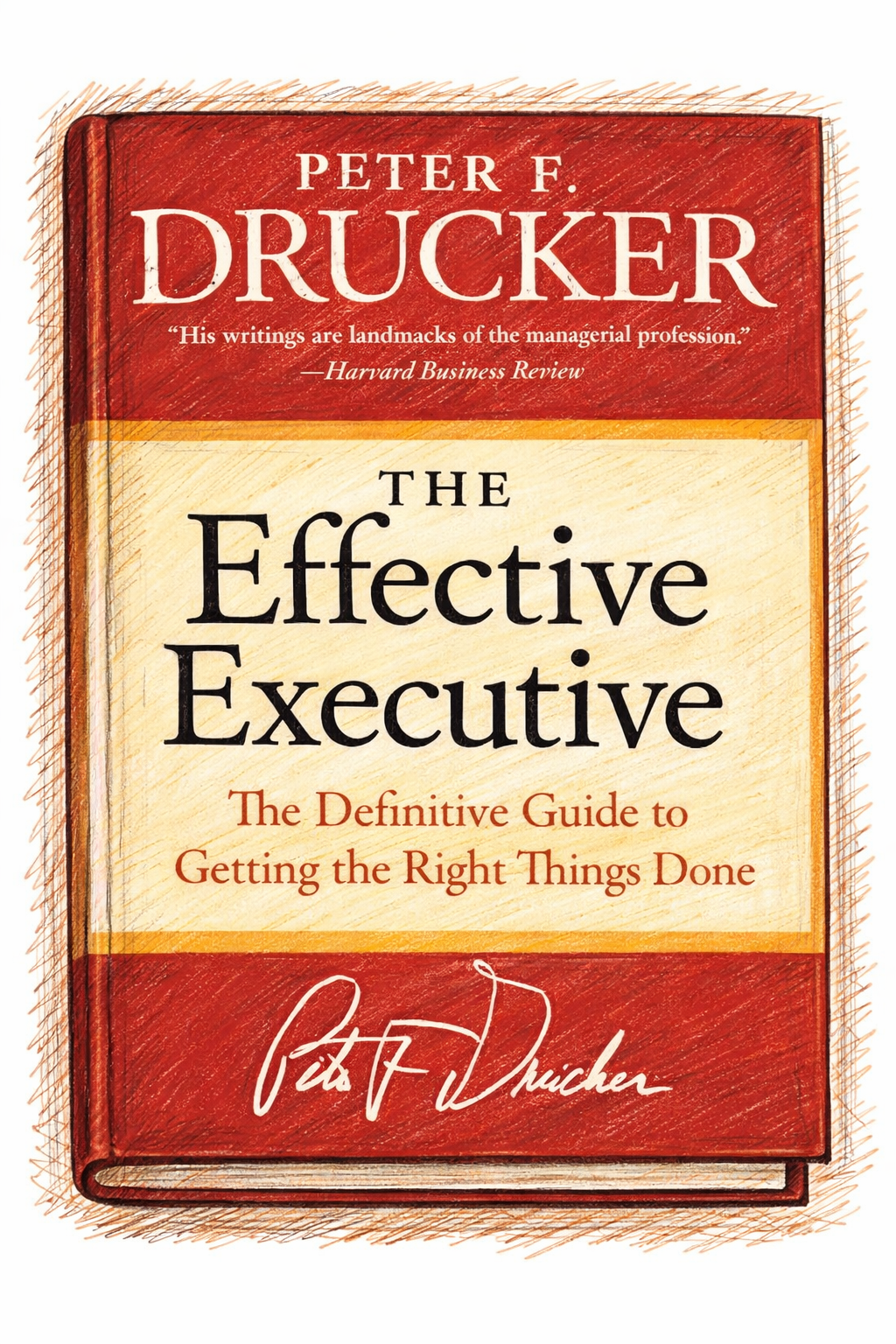
Initially, I did not expect too much from this book. Published in 1966, and filled with examples from companies and governments that no longer exist in the same form. I have read of newer books on productivity and effectiveness, and I assumed this one would feel dated. I was wrong. The Effective Executive turned out to be one of the more refreshing and concise books I have read. It wastes no time, makes no grand promises, and gets straight to how things actually work in practice.
About the Author
Peter Drucker (1909–2005) was an Austrian American management consultant, educator, and author who is widely considered the founder of modern management as a discipline. He coined the term “knowledge worker” in 1959 and spent the rest of his career studying how organisations can make these workers more effective. He advised the leaders of General Motors, General Electric, IBM, and dozens of other major organisations. He authored 39 books, contributed regularly to the Harvard Business Review and the Wall Street Journal, and received the Presidential Medal of Freedom in 2002. His work has been translated into more than thirty-six languages and remains widely studied in business schools worldwide.
Audiobook
The audiobook is available on Spotify family accounts in most countries.
What the Book Is About
The core premise is simple: effectiveness can be learned. It is not a personality trait. Drucker wrote the book for knowledge workers, meaning anyone whose work involves decisions and judgment rather than manual labour. His argument is that these workers need to develop five specific habits.
Know thy time. Effective executives start with their time, not their tasks. They record where their time actually goes, then eliminate what does not contribute. Time is the only truly scarce resource. You can hire more people and raise more capital, but you cannot manufacture more hours.
Focus on contribution. The effective executive asks “what needs to be done?” rather than “what do I want to do?” This outward focus on results is what separates effective people from merely busy ones.
Make strengths productive. You should staff and organise around strengths, not around avoiding weaknesses.
First things first. Effective executives do one thing at a time and, more importantly, they decide what not to do. Drucker calls these “posteriorities” and argues that the courage to set them is what separates effective executives from the rest.
Make effective decisions. Effective executives make few decisions, but important ones. They insist on disagreement before deciding, because if everyone agrees immediately, the decision probably has not been properly examined.
Why This Book Surprised Me
What struck me most was how modern it feels. Drucker was already writing about information overload in the 1960s. He described a world where executives were overwhelmed by reports, data, meetings, and communications. He wrote about this as if it were a new challenge. And yet today, we talk about information overload as if it were born with the internet and social media.
These problems are not new, and Drucker’s solutions have held up ever since. That track record matters. One is better off reading methods that have stood the test of time than picking up a new book that promises a fresh framework but has never been proven.
His thoughts on the computer also hold up surprisingly well. He warned that executives risk becoming dismissive of any information that cannot be reduced to computer logic, and that the sheer volume of computer-generated data could actually shut people off from reality. They start trusting only what the numbers tell them and become blind to what they can perceive but not quantify.
Replace “computer” with “AI” in those observations, and they could have been written yesterday. The first point maps directly onto the current conversation about AI as a productivity tool: it makes you faster, but it does not tell you what to work on. The second is arguably even more relevant now than it was in the 1960s. The temptation to trust AI outputs and dashboards while losing touch with what is actually happening on the ground is a real risk.
A Practical, No Nonsense Approach
Drucker does not paint an idealised picture of how organisations should work. He describes how they actually work. He describes, for example, a brilliant but insubordinate military commander. When someone suggests firing him, the response is essentially: “Are you out of your mind? He gets results.”The insubordinate commander, the political realities of management, the messiness of real decision making. Drucker writes about the world managers actually operate in, which makes his advice more useful.
The link with 7 Habits of Highly Effective People by Stephen Covey
I consider The 7 Habits of Highly Effective People by Stephen Covey to be the best leadership book. The Effective Executive reads like its more practical, work-focused companion. Where Covey gives you the principles for living effectively, Drucker gives you the specific habits for working effectively as a knowledge worker. They complement each other well.
Covey’s “Put First Things First” and Drucker’s “First Things First” are almost identical in title but different in approach. Covey gives you the broader life principle with his urgent vs important matrix. Drucker zooms in on the workplace and adds the concept of posteriorities: actively deciding what to stop doing. Covey tells you why prioritisation matters; Drucker tells you how to do it at your desk on Monday morning.
Covey’s “Begin with the End in Mind” and Drucker’s “Focus on Contribution” both orient you towards outcomes rather than activity. Covey frames it as a personal vision exercise. Drucker constrains it to being effective for the organisation you work for. Stop thinking about what you want to do and start asking what the organisation actually needs from you.
Covey’s “Seek First to Understand, Then to Be Understood” and Drucker’s insistence on disagreement before decisions. Both are about resisting the urge to jump to conclusions. Covey applies it to relationships and communication. Drucker applies it to organisational decision-making: if everyone agrees straight away, you have not thought hard enough.
Verdict
The Effective Executive belongs on the same shelf as Covey’s 7 Habits. It is short, direct, and packed with practical wisdom that has proven itself over nearly six decades. Its age is not a limitation. It is proof that the advice works.