
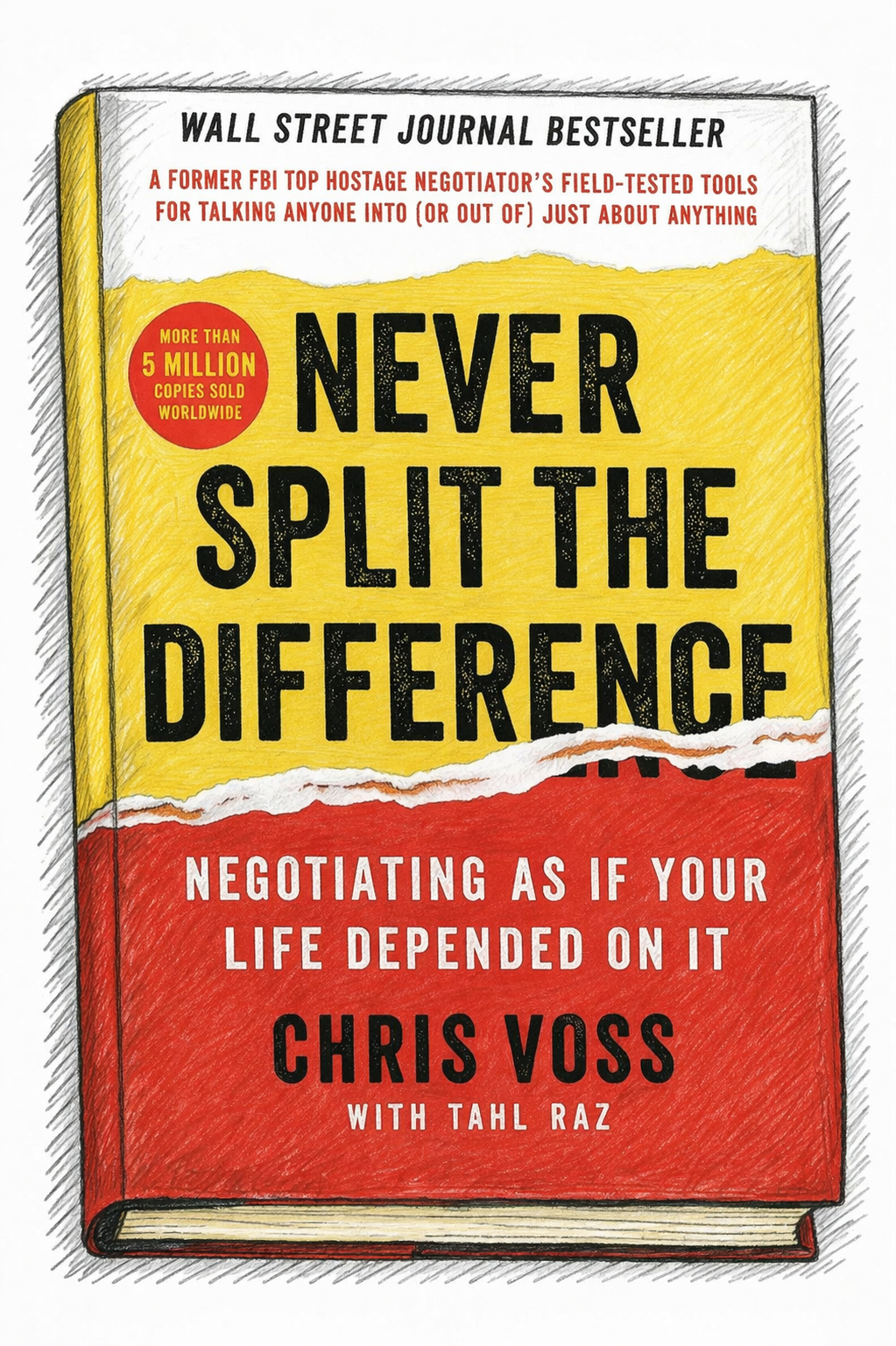
What Is This Book About
Never Split the Difference was written by Chris Voss, a former FBI hostage negotiator. The book draws on his experience negotiating in some of the highest-stakes situations imaginable, kidnappings, bank robberies, and international crises, to argue that the same techniques work everywhere: job negotiations, business deals, and even buying a second-hand car.
The core argument is this: most people approach negotiation as a rational exchange of information and compromise. Voss argues that is the wrong approach. Humans are emotional beings first, and rational second. The best negotiators do not win by being smarter. They win by making the other person feel heard.
The book covers a range of practical techniques. Tactical empathy, mirroring, labelling emotions, the power of “no”, calibrated questions, and the concept of the “black swan”. Each chapter builds on the last, moving from the foundations of emotional intelligence in negotiation towards more advanced techniques for reading and shaping a conversation.
The book is available on most Spotify family accounts (not on Norwegian accounts, though…)
What I Liked
The personal stories are what make this book. Voss is a good storyteller, and you can tell these are real experiences, not fabricated case studies.
He argues that negotiation is a learnable skill. Voss credits his own development to deliberate practice, study, and a lot of failure along the way. That is a refreshing framing, especially in a world where “charisma” is often treated as a personality trait you either have or you do not. I agree with Voss that it’s all learned behaviour. I’m sure I would be a better negotiator if I had lived in a place where bargaining is a daily practice.
Reading this book, I kept thinking about Stephen Covey’s The 7 Habits of Highly Effective People, which I find myself returning to whenever I read in this genre. Covey’s fifth habit is “Seek First to Understand, Then to Be Understood.” He dedicates an entire section to the idea that most people listen not to understand, but to reply. They are already formulating their response while the other person is still talking.
Voss arrives at the same conclusion from a different direction. Where Covey approaches it from a principles-based, character-driven perspective, Voss builds the case from high-stakes field experience. But the core message is the same: the person who listens most carefully has the upper hand in the conversation.
The Black Swan Connection
Voss uses the term “black swan” to refer to unknown unknowns in a negotiation. Pieces of information the other party holds that, once revealed, completely change the dynamic.
If you have read anything in risk management, this term will sound familiar. Nassim Nicholas Taleb popularised the concept of black swans to describe rare, high-impact events that fall outside normal expectations. While Voss uses the term in a narrower, more practical sense, the underlying idea is the same: the most important variables are often the ones you cannot see yet. In negotiation, discovering those hidden variables is often the turning point.
Where I Have Some Reservations
My first issue is the length. Not in terms of page count, but in terms of content density. Some chapters contain three or four strong techniques, wrapped in lengthy FBI stories that, while entertaining, are not always necessary to understand the point. If you are pressed for time, you can start around chapter three or four and still get the core of the framework.
The second thing is that it is a bit tactic-heavy, without much reservation. Yes, these tactics work in general, but by now they are also well known and can backfire. For instance, mimicking, when done well, can make the other person feel more at ease, but when it’s obvious the other person is using tactics on you, it will feel fake, making you raise your guard.
The same goes for the lowball offer tactic. Yes, the anchoring bias is real, and it’s good to be aware of that (Kaneman describes it best). But it can also come across as rude, which can ruin the relationship.
I have experienced this personally when selling things online. Someone sends an offer so far below the asking price that it feels disrespectful. It does not make me want to negotiate further. It makes me not want to deal with that person at all. There is a fine line between anchoring aggressively and signalling that you are not taking the other person seriously.
Those nuances are not always captured in the book.
My Verdict
Never Split the Difference is a useful book. Not just to those in formal negotiation settings, but to anyone who negotiates from time to time, making it applicable to most of us.