
A month ago, I wrote about why everybody needs a personal website. Shortly after, I published a roundup of six personal websites that make you want to build your own. Both posts did well, so the natural follow-up is: how do you actually build one?
What Is a Personal Website?
A personal website is a website about you, run by you, on a domain you own.
It might be a simple one-page CV with your name, what you do, and a way to get in touch. It might be a blog where you write about your work, your interests, or your experiences. It might be a portfolio of projects, a collection of book reviews, a photo archive, or some combination of all of these. What makes it personal is that you are the niche.
You Are The Niche
A personal blog is a type of personal website where writing is the main output. The distinction between a personal website and a personal blog is blurry. For the purposes of this piece, I am using both terms to mean the same thing: a place on the web that is yours, where you share things that come from your own experience and perspective.
What it is not is social media. A LinkedIn profile or Twitter account is not a personal website. Those are rented spaces on someone else’s platform. A personal website is something you own.
Is Publishing on the Web Worth It in 2026?
The question comes up often, and I understand why. AI does most of the writing nowadays, and social media has only increased its user base. So why bother building a website?
My answer is that AI and Social media have taken over traditional blogging. Lists of tips you can find anywhere. Summaries of things that already exist. Reviews written by someone who never used the product. That kind of writing has been commoditised. AI does it faster, more cheaply, and more personally.
What AI cannot do is have human experiences. Those things are still yours. And they are what make a personal website worth visiting.
The standard advice for bloggers was to pick a niche. Focus on one topic, build topical authority, dominate a corner of the internet. And there is still truth to it, but I’d argue it’s becoming less important.
Search Engines Have Become Smater
Search engines have become smarter. They are getting better at understanding context, intent, and the difference between someone who has genuinely lived a topic and someone who has just written about it a lot. The question that will increasingly matter is not “Does this website cover this topic consistently?” but “Is this a real person with real experience?”
You are the niche. The combination of things you know, the way you see the world, your particular history and set of interests, that is not something anyone else can replicate. And as AI content continues to flood the internet with generic information, personal, authentic, experience-based writing will only become more distinctive.
Your Skills are only Valuable if Others Know they Exist
The world is still becoming more interconnected and specialised. With the internet, knowledge work can be distributed to specialists worldwide. It therefore pays off to specialise. And it can hardly be specific enough if you can market your skills across the globe. And that is where personal websites come in. Because your skills are only valuable if others know they exist.
My Journey
I started out on WordPress.com. My first posts were the sociology essays I had been writing during my studies. They had been marked and filed, and it seemed a shame to let them disappear into a folder on my laptop. To my surprise, they still get regular traffic, four years later.
From Platform to Self-hosted
WordPress.com made that easy. You sign up, pick a template, and you are writing within the hour. No technical knowledge required, no cost. For a first blog, it is a reasonable place to start.
The catch is that you do not actually own anything. Your address is yourname.wordpress.com, not yourname.com. You cannot install your own plugins. You cannot customise beyond what the platform allows. And if WordPress decides to change something, you will have to live with it. The good thing is, however, that you can easily export it and host it on your own domain, with a server provider of your choice.
This is where WordPress.org comes in. The software is the same, but you provide the infrastructure. This gives you full control and ownership of what you publish.
Consistent Writing
After the essays, I started writing about things I was simply interested in. Less academic, more personal. Things I was reading, places I had been, ideas I was turning over. The posts were rougher, more tentative. I was figuring out what kind of writer I was and what kind of website I wanted to have.
I only really started writing consistently when I began my master’s in risk analysis. I had a lot of new material to absorb, and I found that writing about what I was learning made me understand it better. But more than that, writing for an audience, even a small and hypothetical one, made the work feel worth doing in a different way. It is a lot more motivating to write a clear explanation of something if you think it might actually help someone. You raise the bar for yourself in a good way.
At the same time, I was trying to build a network in a foreign country. The blog functioned as a tool for that. When I met someone and wanted to stay in touch, I could send them a blog post I thought might interest them. At the same time, this provided my contact details.
Serendipity
But mostly the blog has led to unexpected connections. A professional studying risk management on the other side of the world, reconnecting with friends from high school and businesses reaching out asking me to market their product.
That is the serendipity part. You write, you share, and things happen that you could not have planned for. The longer you do it, the more surface area you create. The more surface area you create, the more likely something interesting is to land on it.
How To Get Started
If you were to ask me what the best way to get started is, I would recommend the following steps. I tried to keep it general so it can be adapted to different types of personal websites.
Stage 1: Be Findable

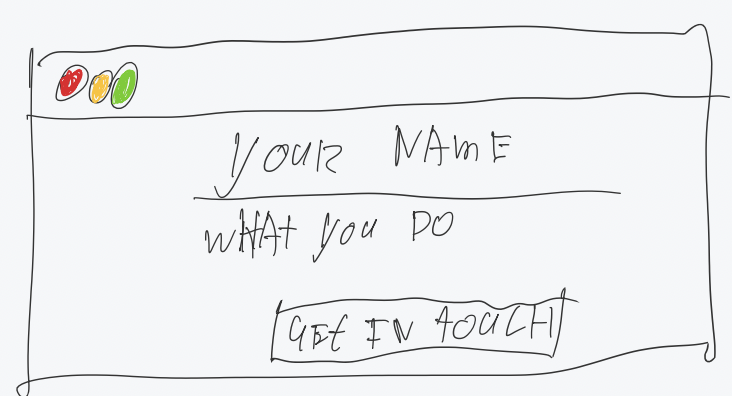
The first and most valuable thing to do is to get a domain with your name and put up a simple page. Your name, what you do, and how to get in touch. That is it. A paragraph of bio, a contact form, and maybe some links to your social media.
This sounds minimal, but it helps a lot. When someone Googles you after a conference, before a job interview, or because they read something you wrote, what they find shapes their first impression before you have said a word.
For most people, that Google search turns up a Facebook profile they haven’t updated since 2019 and a cleaning rota from the local sports club they are listed on. That is the baseline. A simple page with your name, what you do, and a contact form already puts you ahead of the vast majority. No portfolio or blog posts needed.
For a starting platform, WordPress.com is free and gets you going in an afternoon. The advantage of WordPress.com is that you can easily migrate your website later to a self-hosted website with your own domain. As said before, this should be your goal, because only then will you have ownership of what you publish.
Stage 2: Share What You Already Have

Your first posts do not need to be new. What have you already made that is sitting on a hard drive or filed in a folder somewhere?
Essays from university. Notes from courses you have taken. A process you have figured out at work that took you ages to learn. A review of a book that changed how you think. A presentation of something in your field that you have given to a non-specialist colleague at least three times.
That is valuable content. Publish it.
Starting with existing material solves the blank-page problem. It also means your earliest posts are some of your most substantial, which is a better start than starting from scratch. And some of those posts, the ones that answer a specific question in a specific subject area, will quietly accumulate traffic for years. My sociology essays are proof of that.
Position Yourslef as a Student, Writing to a Friend
The best writing tip I can give is to position yourself as a student, writing to a friend. When you do that, you overcome the imposter syndrome. You don’t have to be an expert to write about a certain topic. In fact, writing that about where you struggle and admitting that you don’t have all the answers makes your writing human.
Imagining yourself writing to a friend makes the writing more personal and specific. Don’t try to write something that will appeal to everybody, because it will appeal to nobody.
Stage 3: Build a Workflow

Quality matters most. Publishing one good piece of content is worth much more than 10 mediocre pieces. But if I’d set myself the rule of only publishing something I’d believe that was of really high quality, I would have published next to nothing. The content can always be better, so there needs to be a point where you say, I will publish this now.
This is where consistency comes in. To publish quality content, you need to publish regularly to figure out what works.
What makes consistency possible is having a workflow that is small enough to fit into your actual life. I set myself the goal of publishing 1 blog post a week. My workflow that achieves this looks like this.
- Keep a running list of ideas.
I keep a list in OneNote, with each page as a potential title for a blog post. Often, the best blog post ideas are literally questions people ask me. ”How did you study for your exam?” or ‘What tools did you use for your literature review?” Most of the time, I don’t even write anything on the page itself; the title speaks for itself.
Once you get into the habit of writing these ideas down, you will never run out of things to publish about.
2. Write or record a rough draft.
The next thing I do is to write or record a rough draft. If it’s more research-focused, writing is often better. If it’s more of a personal story, I often talk directly into an LLM and have it transcribe for me.
3. Use AI to edit and then publish.
I sometimes use AI for brainstorming. But the best use case I found is to only use it as an editor. The more AI you use, the more you will sound like a robot, which is not authentic.
Everything AI can think up on its own is not worth publishing. The explanation is simple: if the LLM can provide this insight to you, it can do so to others. So use AI to help you articulate the insights that only you, as a human, can have.
Everything AI can Think up on it’s Own, is Not Worth Publishing.
This whole process for a medium-length post might take three to four hours spread across a week. That is sustainable.
Stage 4: Let Serendipity Happen

That is it, there is actually not much more to it. People will now be able to find your work and connect with you.
Although the process is simple, it does take time for your site to be indexed by search engines. And it can take weeks to get a little bit of traction, if you get any at all. Especially if your site is new, and therefore hasn’t got any authority yet. There is also more noise than ever on the web, with many people creating low-quality AI content.
I do therefore recommend sharing your work on social media if you want to drive more traffic. I don’t like the idea of giving my content away to big tech and letting them do with it as they please. But if you want to reach people, you will need to publish content where those people are.
Concluding
Three years ago, I put some sociology essays online because I wanted to share them with others.
Since then, the blog has helped me land a job in a foreign country, connected me with professionals I would never have met otherwise, and given me a reason to keep learning and writing things down. None of that was predictable from the starting point.
It’s not hard to build a website anymore, and it doesn’t have to be costly either. Also, you have plenty to share, and the sooner you put it out there, the better.
If you want to see what is possible, have a look at the six personal websites I found that make you want to build your own. And if you are not yet convinced that it is worth doing in the first place, I wrote a few months back about why everybody needs one.