
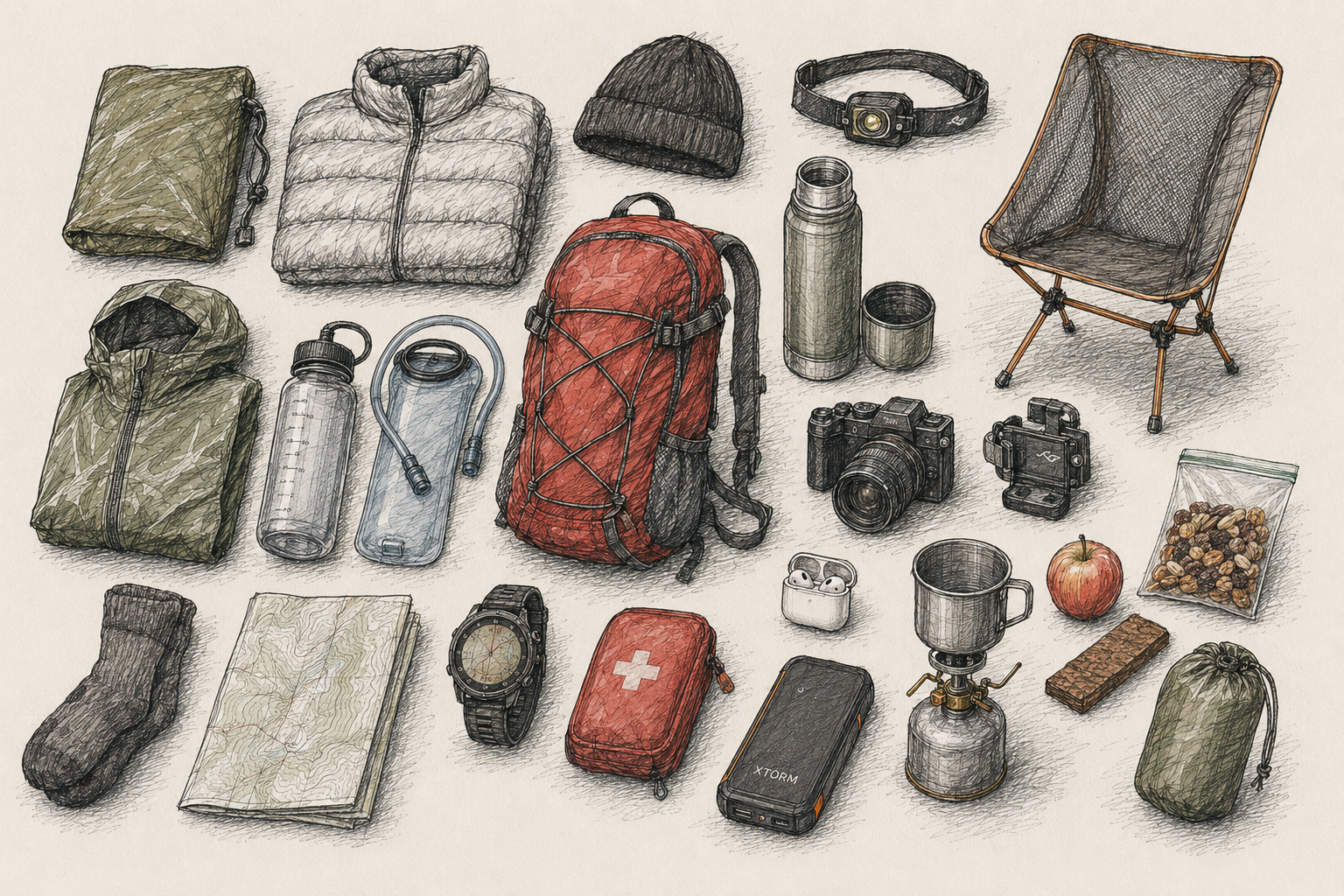
This week I’ve been planning our upcoming trip to Surtningssue, peak number two in our Seven Summits of Norway project. Getting into packing mode got me thinking about what I actually bring on a hike here in Norway, and it seemed like a good moment to write it down.
There’s no one-size-fits-all answer to this. Every hike is different in duration and terrain, and the weather in Norway varies wildly, so what goes into the bag changes. That said, certain things make it into the pack almost every single time.
Rain Gear
If you hike in the Norwegian West Coast, you hike in the rain. My preference is a large poncho that goes over the backpack. It keeps both you and your pack dry in one go, and it doubles as something to sit on during a break. A good shell jacket is, of course, also an essential. That will keep the wind out, and is sufficient for light rain.
Water
Talking about water, on shorter hikes, I usually just bring a water bottle. Norway is rarely hot enough to need anything more. On longer hikes, a camelbag is worth considering, mainly because it allows you to drink on the move without stopping or digging into the side pocket of your pack.
Wireless Headphones
They weigh almost nothing, so there’s no reason not to bring them. On some hikes, I want nothing but the sounds around me. But on others, it’s nice to have the option of a podcast or some music. Also, when you’re on a call and walking in terrain at the same time, holding a phone while scrambling over rocks is exhausting.
Smartwatch
I’ve been using the Garmin Fenix 5X watch for years, and it has outlasted my expectations by a wide margin. The main reason I went for it originally was that it was one of the few watches at the time that had proper maps built in. There are more options now, but the Garmin has been so reliable that I’ve never felt the urge to switch.
Navigating on the watch rather than the phone makes a real difference out in the field. You’re not constantly taking your phone in and out of your pocket, you’re not running down the battery, and in the rain your phone’s touchscreen becomes unreliable anyway. I pre-plan a route, load the GPX track onto the watch, and use that to navigate. If you go off-trail, it notifies you. It keeps the whole experience far more practical.
After all these years, though, the battery life is not what it used to be. In summer, on a day hike, it still holds up fine, but in winter, the cold takes a real toll on it. I’ll be upgrading at some point, probably before next winter.
You can pick up a second-hand Fenix 5X for very little these days, which is excellent value if you’re looking to get started with GPS watch navigation.
Hot Drinks and Food
For hot water on longer trips, I used to bring my lightweight titanium cup with a small stove setup, but I’m increasingly just going with the thermos. It’s quicker, simpler, and keeps things warm long enough for most day hikes.
On the food side, I lean towards carbs on longer hikes. Things that are easy to digest. Fruit works well, and salty foods are good to have if you’re sweating. The key thing is to figure out what you perform well on before you’re already three hours into a mountain and relying on trial and error. Test your food on shorter hikes first.
Warm Layers and Dry Clothes
This is a topic that can go quite deep, but the basics are: base layer, mid layer, shell. That’s the foundation, and it applies here as much as anywhere.
One specific addition I’ve started using is a wool mesh shirt as a base layer. These have been around in Norway for years, and they’re becoming more popular elsewhere, too. The key thing with the mesh shirt is that it needs air circulation to do its job, so make sure you have a looser layer on top of it. In summer, I’ll wear a loose shirt or just the shell over it.
A down puffer jacket goes in the bag as a low-activity layer, something to put on the moment I sit down for a break or stop moving for any reason. Even in summer, you cool down fast when you stop. It’s also just good safety practice: if something goes wrong and you or someone else ends up waiting on a mountain for any length of time, having something warm to put on matters. The majority of rescue cases involve hypothermia, so it’s essential to bring enough clothes to stay warm. Also in summertime. A hat falls in the same category: too warm to wear while moving, but important to have available.
Extra socks and a dry shirt are also worth adding, because your feet will likely get wet at some point, whether from a stream crossing, wet grass, or just sustained rain. Once you’re wet, you will be cold.
First Aid
A small first aid kit, always. For our upcoming Surtningssue hike, I’m also adding an emergency bivvy bag to the kit. We’ll be doing longer, more remote hikes now as part of the summits project, and in an emergency where rescue could take hours, having something to keep me or someone els warm while waiting is critical. It’s not something I’d take on a short, well-trodden trail close to the city, but it earns its weight on more serious objectives.
Powerbank
Not so much to say here, apart from that I would recommend one that shuts off when your device is full. You might want to use it whilst camping to charge your devices overnight, and you don’t want it draining unnecessarily. So make sure to check for that feature. I am using the Xtorm XR202 Rugged Powerbank 20,000 mAh. In the same category, I almost always bring a headlamp. You never know for certain how long you will be out there.
Peak Design Capture Clip
If you bring a camera on hikes and you don’t already own one of these, you’re making life harder than it needs to be. The Peak Design Capture Clip attaches directly to your shoulder strap and holds your camera securely while you walk. You can grab it in one smooth motion, and it locks back in just as quickly.
Without it, my camera tends to stay in the bag for most of the hike because it’s too much hassle to take it out. The connection is sturdy, and I’ve never had any concern about it coming loose, even on technical terrain.
Grand Trunk Mayfly Chair
This one might be surprising, but hear me out.
I bring a lightweight camping chair on hikes where I know there’ll be a proper break. The Grand Trunk Mayfly Chair is the current version of a chair that used to be sold as the Alite Monarch. It stopped being produced for a while, and it seems to be back now under Grand Trunk. It packs down small and is very comfortable. It will make your well-deserved break so much more comfortable.
Concluding
Next weekend we’ll be heading up to Surtningssue, peak number two in the Seven Summits project. I’ll be writing up the full trip report afterwards, so keep an eye out for that. And if there’s something you always bring that I haven’t mentioned, let me know in the comments.