
Surtningssue is the seventh and lowest of the seven highest peaks in Norway, and the one we had marked as an early-season objective. At 2,368 metres, and without glacier or rope climbing, it is the least technical of the seven. Yet this doesn’t mean it is a walk in the park.
Gjendesheim
Gjendesheim sits at the eastern end of Lake Gjende in Jotunheimen, and it is a solid base for the start of this trip. The cabin is comfortable, and the food is good. One thing worth knowing if you are planning a trip: you cannot book a bed without also booking dinner. If you are on a tight budget, that is worth factoring in.
We met two friends there, who happened to be on holiday in Norway at the same time. The four of us would be attempting Surtingssue the following day.

The Boat to Memurubu

The plan was to take the first boat of the day across Lake Gjende to Memurubu, the cabin on the western shore that serves as the starting point for the Surtningssue approach. The first departure for us was at 07:45 and takes about twenty minutes.
Memurubu itself was still closed for the season. It opens in late June, so we had known in advance that we would need to be self-sufficient. We had packed camping gear for one night, which we left at the cabin before setting off. That way, we would have shelter and food waiting when we returned, regardless of how the day went.
The Attempt

In the days leading up to the hike, the forecast had looked good. Then, the day before, it shifted. A lack of wind meant the rain clouds sat stubbornly over Jotunheimen, and the forecast flipped to a full day of rain in the valley and snow higher up. Saturday was our only option. We needed both days for the drive, so there was no flexibility to wait it out.
We decided to go anyway. The weather in the mountains moves, and you never quite know until you are out there.


The first obstacle came early. The seasonal bridges over the river near Memurubu had not yet been put in place, which is normal for this time of year, but it added an unexpected challenge. We spent the best part of half an hour working out a crossing, trying to hop rocks before accepting that wading would have been both quicker and safer.
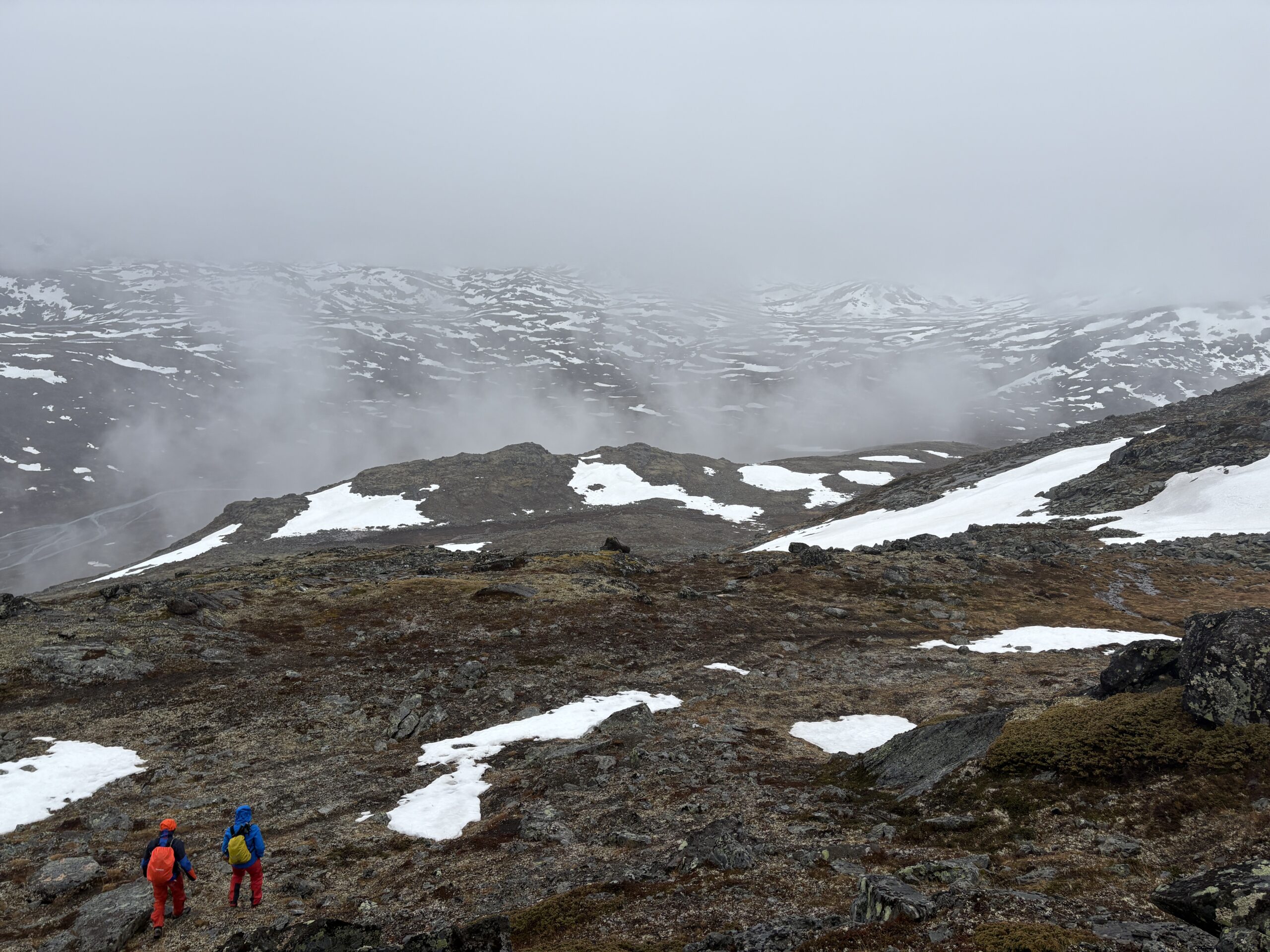
We made reasonable progress despite the rain, covering about five kilometres and reaching roughly halfway up the ascent. Then we hit a larger snowfield. There had been patches of snow lower down, which we had expected, given what we could see on the surrounding mountains, but this one was larger. The snow was soft and unconsolidated, and we were sinking through it with each step.
With the time already eaten up by the river crossing and the lower snowfields, and both of us thoroughly soaked and starting to feel the cold, we made the call to turn around.
The route up Surtningssue can be done as a loop, with a steep ascent on one side and a longer, flatter return on the other. We considered approaching from the return route instead, but by the time we reached the junction, that option had run out of time, too.
In hindsight, we were a little too eager. It was still early in the season, and in combination with the bad weather, Surtingssue was not ready yet for a summer attempt to the top.
The Old Cabin at Memurubu

Back at Memurubu, cold and wet, we went looking for somewhere to shelter and prepare some food. The main cabin was still locked for the season, but one of the older outbuildings was open: a small stone cabin, half-dug into the hillside, with a grass roof and an open fireplace at the back. Originally built in the nineteenth century and renovated by DNT in the 1930s to preserve some of the early tourism history of the area.


The cabin was dark and cold when we arrived, with only a small window above the door. The stone walls radiated the chill like a cellar. But there were some wood offcuts left behind from maintenance work, which gave us enough kindling to get a fire going. It took a while for the room to respond; the rocks absorbing more heat than they gave back for a long time, but sitting close to the fire eventually did the job. We warmed up slowly, dried out as best we could, and prepared some food on the hot embers.
There was no phone reception. Just the four of us, the fire, and a cabin that felt entirely unchanged from when it was first built. I journaled a bit by candlelight before we went to bed early and slept deeply.
The Morning After
The next morning, we cleaned up the cabin, left behind matches and tinder for the next hikers, took the first boat back to Gjendesheim, caught the shuttle to the car park, and drove home. Mostly in sunshine, as it happened.
A mix of feelings on the way back. It is always good to be out, and the evening in the old cabin was a cool experience. But it is hard to ignore the practicalities. Jotunheimen is a ten-hour drive from Stavanger, and the costs stack up fast: accommodation with dinner and breakfast at Gjendesheim, the boat across Lake Gjende and back, shuttle buses, parking, and food on the road. For the two of us, the weekend came to around 4,400 NOK. That is a lot to spend on a hike in the rain… If it had been a local trail, we would have shrugged and called it a good day out.
The mountain is not going anywhere. Surtningssue will be there when the season is further along, when the bridges are up, when the snow has consolidated or cleared, and when the forecast holds for more than twenty-four hours.
Up Next: Proper Climbing
Next week, we will be going back to Jotunheimen to meet up with a guide. We are not sure yet which mountain to attempt; we will have to see what the weather has in store for us and what the conditions are like on the mountain.
Whatever it will be, I’ll be back with another report.