
After a failed attempt on Surtningssue the weekend before, we headed back to Jotunheimen to tick off the next mountain on our list: Skardstinden. At 2,373 m, it is Norway’s fifth-highest peak. The route is mostly a long, demanding hike, but it finishes with four roped scrambles in a row along an exposed ridge. The climbing itself is easy, so this is a doable guided trip even if you have no climbing experience, but you should be in good physical shape.
Driving In and Setting Up Camp
We drove from Stavanger to Leirdalen on the Friday, which took roughly 9 hours including stops along the way. Leirdalen is a great spot to camp; it’s in a beautiful valley surrounded by many mountains. It’s plenty of good pitches on the grass, so we set up our tent there for the night, close to the starting point at Geitsætra.

Since neither of us has experience leading climbs in the high mountains, we decided it was safest to book a guide for this summit. The guide arrived the evening before, and we made a plan for the next day together. Because the forecast showed clouds rolling in later in the day, we agreed to start at 6.00. After the planning, we made dinner: salmon with onions, asparagus wrapped in ham. Then we went to sleep around 21.00, getting a good night’s sleep before the long day ahead of us.

Climbing Skarstiden
We were up at 5.00, packed our gear, made breakfast, packed snacks for the day, and then set off at 6.00.
The hike starts at 1000 moh from Geitsætra. Up towards Raudhamran, it is quite a tough, steep walk. It is a long, steady gain of around 1,000 metres in elevation on a path that gradually gets worse the higher you go, with the surface shifting from grass to stones. Around 1,950 m, the terrain flattens out, and the hardest part of the climb is behind you. From there, it’s an easy walk across small scree to Vestre Skardstinden.


At Vestre Skardstinden, we put on our harnesses and helmets, then started the walk over to the first of the four ‘hamrene’, which is Norwegian for a craggy rock face or cliff. This part felt a little sketchy; the path along the edge is narrow and exposed with a real drop on either side, but we crossed it without securements since conditions were dry. Our guide climbed the first pitch, set up the belay, and then we followed. After topping out, there’s a short stretch of walking before the next three hamrene come one after another, slightly shorter than the first but every bit as airy. The climbing itself was easy and fun rather than technical, but the exposure makes it feel a bit scarier, at least in my opinion, but I guess I might have a bit of a fear of heights.

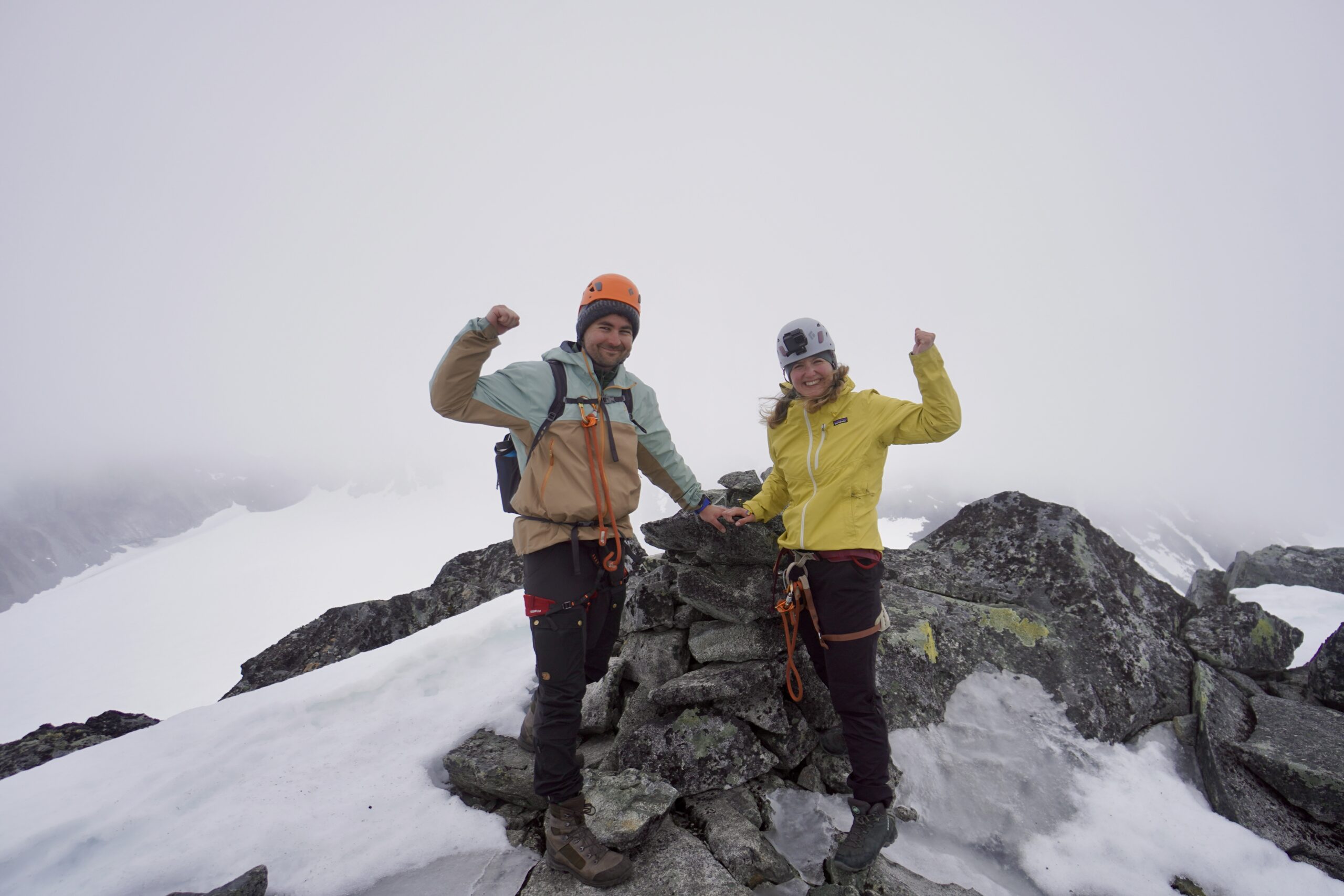
All four hammers went by pretty quickly, and then we were at the top. Just before the top, we could see the amazing view, but by the time we reached the top, it was all clouds and fog. We are used to summiting in the cloud by now; it seems to be a running theme on our trips, so we got our summit fog photo and then started heading back down.
The way down
On the way down, we rappelled all four hamrene back to Vestre Skardstinden. From there, the long descent back down towards Raudhamran is the part that really wears you down, a steady, repetitive 1,000 metres that feels like it never ends. At this point, we had been out for about 5.5 hours and stopped for a short break and a slice of bread along the way.

The descent normally goes faster than the ascent, but I have some weakness in my knee on downhills, so our pace was on the slower side. We were lucky with the weather, though, just a couple of brief rain showers, nothing that lasted long. After 10 hour and 15 minutes, we were back at the car. We said goodbye to the guide and went down to the cold glacier river to rinse off before heading back to camp. The water was ice-cold, but it was nice to get a little shower.

Then we ate real turmat and had an earned beer. We were both completely worn out, so we were in bed by around 6 PM and fell asleep early. The next morning, we woke around 6 AM, and I don’t think I have slept that well in a long time.
It was a success, and we are now 2 summits down with 5 left to go!
What you should look into if you are interested in doing this hike
If Skardstinden is on your list, here are a few things worth sorting out before you go.
Book a guide well in advance if you don’t have experience leading climbs in the high mountains. The four hamrene require roped scrambling along exposed terrain, and while the climbing itself is easy, you want someone who knows the route and can set up belays safely. Guides for routes like this tend to get booked up during the summer season. There are several guides in the area; we used Hansen Guiding, whom we highly recommend.
Make sure you’re comfortable with several hours of steady, repetitive elevation gain, both up and down. The climb to Raudhamran and the descent afterwards are where most of the real effort goes, not the climbing section itself. If you struggle with long days on your feet, build up some training hikes beforehand.
Bring proper footwear and check conditions with your guide in advance. Mountain boots are recommended, but low hiking shoes can work if there’s no snow on the route that season.
Don’t let a fear of heights necessarily stop you. I was a bit worried about this beforehand, and I did find the unsecured section a little uncomfortable, especially with the drop on either side. But as our guide pointed out, I didn’t freeze up or panic; I just kept moving. If you’re unsure whether you’ll manage a trip like this, talk to your guide beforehand.
Cost Breakdown
- Guide: 7,200 NOK (3,600 NOK per person)
- Rental car: 2,151 NOK (our own car was in for service)
- Food: 500 NOK (we already had real turmat and salmon at home)
- Bompenger and ferries: around 850 NOK
- Petrol: 1,000 NOK
Total: 11 551 NOK
This trip came out a bit more costly than usual because of the rental car and the guide. But since we camped for free, at least we didn’t have to pay for camping.
Summing up
All in all, I’m very happy with how the hike went. Usually, it’s just the two of us hiking together, and we set our own pace without ever really worrying about a deadline to finish. Hiking with a guide this time made us realise it’s smart to train a bit more before tackling longer routes like Storen. We used about 10 hours here, but Storen could easily take us 15, and that’s not a pace we want to be at. Being in a bit better shape would also just make the trip more enjoyable overall. For the most part, this was a great trip, but as I suspected, my knees gave me trouble on the way down, so before the next summit, I’m planning to focus on training my quads.
The 1,000-metre climb to Raudhamran alone demands real fitness and endurance, and the four hamrene that follow call for comfort with exposed, undulating terrain and a steady head for heights. Hiring a guide for the climbing section felt like the right call for us, given that neither of us has experience leading in the high mountains.