
7-toppturen in Jørpelandsheiene
When we told friends about our ambition to climb Norway’s seven highest peaks, they told us about a hike in the Jorpeland area that goes through seven peaks (there are actually two 7-top tours). This seemed like a good little side quest for our 7 Summits project. And a welcome one, since the travel time to Jotunheimen proved to be too much to combine with other obligations. So we have decided to make this a two-year project.


The weather looked good on Sunday, so we decided to give it a go. It’s a demanding hike, so we packed the night before and left early.
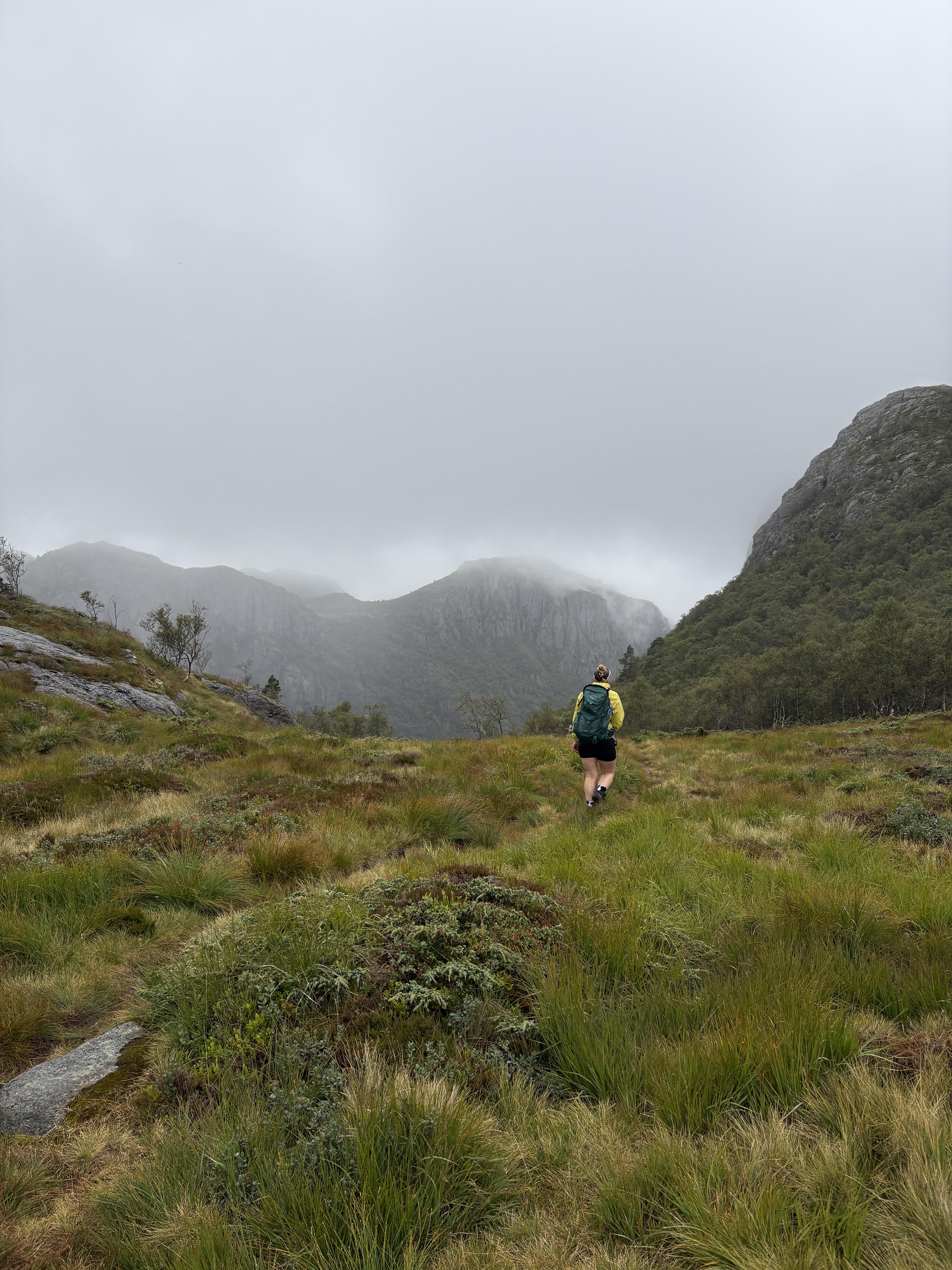
Despite the forecast calling for sun, it was raining as we drove up to the parking lot and started hiking. The steep uphill at the start of the climb with many exposed tree roots became a slippery, uneven staircase. ‘The weather must get better,’ we said to ourselves. After the first peak, with the steepest part of the hike behind us, the clouds seemed to make some way. We decided to push on to another peak and see how the weather developed.
Getting to the second peak involved some scrambling along an exposed edge. It was still drizzling, making the rocks slippery. With a video of somebody slipping on a mountain hike and almost falling down a cliff fresh in our minds. We decided to take the next path back to the parking lot.


Turning around
When climbing in the mountains, turning around often requires more courage than pushing on. You have prepared and travelled to reach this mountain and may be close to summiting. The temptation to push on is real.
But reaching the top is not the ultimate goal; that is getting down safe and sound. Most accidents happen on the way down. So always keep enough energy ‘in the tank’ for the descent.

Luckily, we have the Norwegian ‘mountain rules’ (fjellvetreglene) to guide us. Rule number 8 says: ‘turn around in time, there is no shaming in turning around’. All the Norwegians I have ever met are familiar with and acknowledge these rules as good practice.
It’s not surprising that everybody is familiar with these rules. Ever since moving to Norway, I have been surprised by how often I see these mountain rules. They are famously on the inside of the KvikkLunsj, a Norwegian chocolate bar. And of course you find it on all sorts of publications from the tourist association. But more surprisingly to me, these rules are also decoration. For example, on a nicely decorated sign in Norwegian cabins.
I’ve never seen rules used as decoration in the Netherlands. In many cases, people see rules as necessary and important. But also as limiting rather than encouraging. I have yet to see a Dutch person putting up his or her favourite rules as decoration in the house.
Norway’s high-trust society
For me, this signals Norway as a high-trust society. A high-trust society is one where interpersonal trust is relatively high and ethical values are widely shared. This means that when confronted with rules, regulations, and institutional advice, the general consensus is that these institutions know best, and people follow their advice with little to no hesitation.
It is a good starting position, and I am happy to live in a country that has high trust in its institutions. Yet, it’s also acknowledged that trust is not automatically protective. In some risk domains, trust in authorities can reduce perceived risk, increase reliance on external help, and encourage passivity or wishful thinking rather than personal action (Seebauer 2017), Yang (2023). The mountain rules emphasise self-reliance, though, so I’d argue they create more awareness rather than a reduced perception of risk severity.
All in all, this year’s hikes and climbs in bad weather have been an unwelcome theme of our Seven Summits project (there have been quite a couple!). But it has taught us a lot about how to prepare for a climb, when to turn around, and, most importantly, cherish good weather when it’s present.
Sources
- Seebauer, S., Seebauer, S., & Babcicky, P. (2017). Trust and the communication of flood risks: comparing the roles of local governments, volunteers in emergency services, and neighbours. Journal of Flood Risk Management, 11, 305 – 316. https://doi.org/10.1111/jfr3.12313
- Yang, X. (2023). The influence of trust on the public’s environmental risk perception: evidence from China. Local Environment, 28, 728 – 738. https://doi.org/10.1080/13549839.2023.2173730