
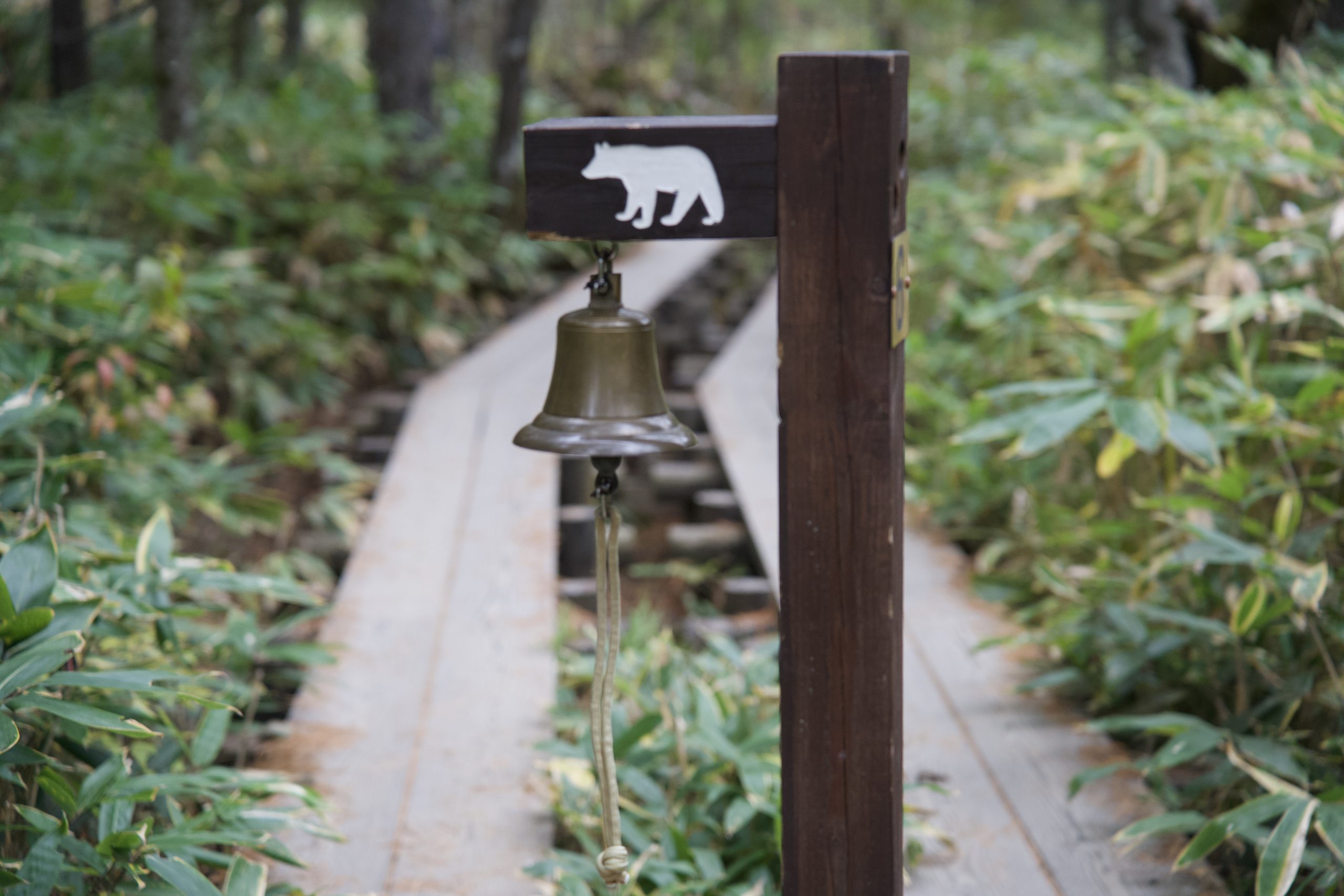
Before our trip to Japan, I didn’t even know bears lived there. I only found out when we were driving on the highway and passed a “beware of bears” sign. Bears aren’t the only wild animals Japanese live close to. We also saw a monkey while driving through the Japanese Alps, and on the outskirts of Kyoto we saw a wild boar roaming around one of the Shinto temples we visited.
I am interested in both the outdoors and safety management, so I find it very interesting how different places communicate the risks of wild animals. My experience with bear safety comes from my time in Svalbard, where I received polar bear safety training. The bears here in Japan are very different, of course, but it is still interesting to compare how these two places deal with a similar risk.
Signs and Information
The first sign that made us aware of the bears was a traffic sign like the one below. I found this picture in an article on the Japanese news website Yomiuri. Bear attacks have increased in Japan, and the article says that more than half of people planning a trip into nature last autumn changed their plans because of it. Experts say the main reason is the growing bear population. A bad harvest of acorns and beechnuts, fewer hunters and people leaving rural areas also play a part.

Source: Yomiuri Shimbun
Mt. Fuji
Close to our campsite at the base of Mount Fuji, we saw more signs. Most were posted on gated roads. We didn’t see any by the hiking trails. My guess is that putting up a scary bear sign also helps keep nosy adventurers off private roads.


The Japanese Alps
In the Japanese Alps, we saw most signs and information about bears. The white bear symbol on the wooden signposts reminded me of the signs in Svalbard. In Norway, warning signs with an animal on them have a white background, so the polar bear sign started out as a black bear on white. Eventually, they changed it to a white bear on a black background, which at least matches the bear. In the Japanese Alps we saw white bear symbols for black bears, which I think is a bit ironic. Maybe the two places can swap signs. 😉


Source: Royal Geographical Society, Svalbard: people, place and polar bears
But I digress. Back to the Alps, which are beautiful. We had not seen much autumn colour yet, as we are a bit early in the season for that. Higher up, though, the autumn colours are already clearly there.


At the start of one of the hiking trails, a small wooden hut had more information on bear safety, plus a form and a letterbox. The form is a trekking itinerary. You fill in where you are going, who is with you, how long you plan to be out, what gear you carry and an emergency contact. Hikers on the trails are expected to hand one in before they start; if something goes wrong, the form’s information makes the search much faster.


Another sign warned about rockfall and fallen trees, and explained that the trail is kept as natural as possible. It’s very much the same philosophy as in Norway. Nature is available for everybody to enjoy, but those who venture out are responsible for taking the right precautions.
The most powerful bear-safety message I found was the observation plaque. It really makes you aware that these precautions are more than a formality, and that bears are actually in the area.

Summing up
Our trip is slowly coming to an end, and we are heading back towards Tokyo. I don’t expect to see much more wildlife, but we still have a stay at a remote temple planned, so anything is possible. It would be exciting to see a wild black bear, but only from the safety of our campervan or a building.
What’s interesting about this trip is that Norway and Japan are quite similar in some respects. In both countries, nature is open to everybody, and that freedom is valued. At the same time, the responsibility is clearly on the hiker. There are few guardrails, fences or bans. You are free to go out, but what happens next is your own responsibility.